

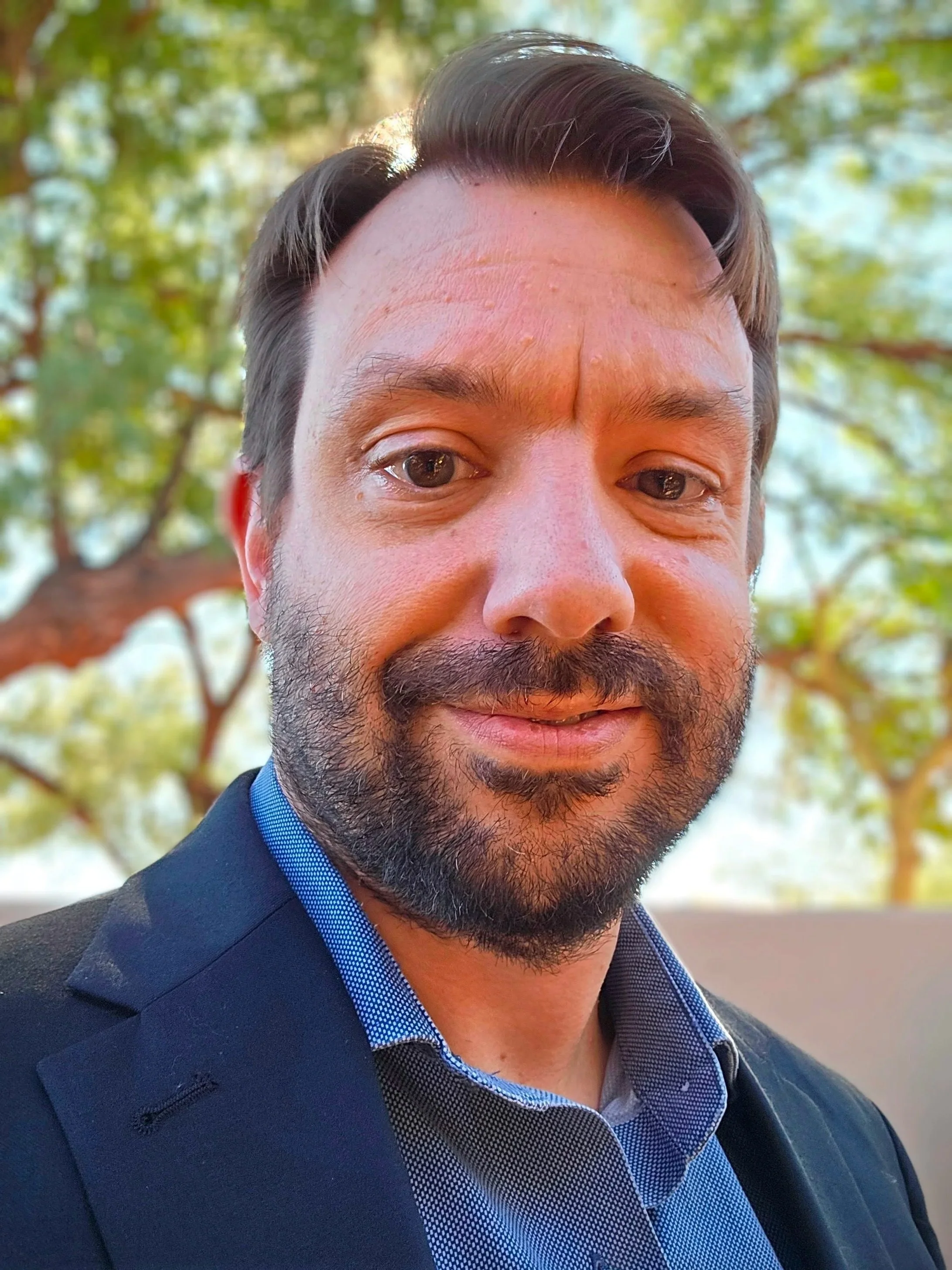
Ben Couch
Owner, elumenEd
Good training changes something.
That's the mantra. It's the test I apply to every program I build, every curriculum I review, every engagement I take. If a training doesn't change behavior, it doesn't matter how polished the slides are. It didn't work.
This is the work I've been doing for 24 years — and it's the work I'm now bringing to the rest of the industry.
How I got here
I came to senior living through a classroom.
From 1998 to 2002, I taught composition and literature to undergraduates at the University of Arizona while finishing my Master's degree in American Literature. Four years in front of freshmen who didn't choose to be there, teaching them to write a thesis and defend it. That's where I learned the craft I've worked in ever since: how to take an idea out of your head and put it into someone else's — clearly enough that they can use it, and convincingly enough that they want to.
I'd been teaching in another form even longer. I earned my first black belt at 14, and my instructor put me in front of a class the same year. Different subject, same skill: meeting students where they are, breaking complex movements down into pieces they can repeat, and building the repetition until something clicks. By the time I walked into a graduate-level English seminar a decade later, I'd already been a teacher for ten years.
The career version started in 2001. David Barnes — who would go on to become the CEO of Watermark Retirement Communities — recruited me to build the training function for The Fountains. I was new to senior living. The national directors had spent careers in it. My job was to sit down with each of them, draw the operational knowledge out, and turn it into training that worked across an entire portfolio.
Twenty-four years later, that's still the work.
What I built at Watermark
Over those 24 years, I built the national training function from a clean sheet. The Learning Center — Watermark's custom-coded learning management system — was the spine of it. I worked with the developer to design the interface, mapped hundreds of skills to every position from hourly caregivers to chief officers, built most of the training myself, and handled every report request, every state-by-state compliance variation, and every user support ticket from the field for years.
I also built the programs that lived around the training. The Partner Program rewarded top hourly caregivers with development opportunities and a path forward — built specifically to address turnover at the line level. GO Ripples was the company-wide onboarding program, with versions for both communities and corporate, and I personally delivered every corporate orientation for years. And Ripples, the recognition program, collected stories from associates whose work changed residents' lives — and reminded everyone, every month, what the job is actually about.
When COVID hit, Executive Director turnover went from a chronic problem to an acute one. EDs were leaving the industry faster than communities could replace them, and every departure cost six figures in recruiting, lost continuity, and operational disruption. I built a targeted development program specifically for that role — an investment in keeping our highest-stakes community leaders rooted, supported, and growing. Longevity in the role moved meaningfully in the right direction. It's still some of the most consequential work I've done.
By the time I left in March of 2025 — just before the Keppel acquisition — Watermark had grown to 80 communities and 6,000 employees in 23 states. The training function I'd built was the function I left behind.
What my mother taught me
In 2022, my mother was diagnosed with Alzheimer's disease.
I had spent two decades building dementia training. I had a rolodex full of national directors, nurses, memory care specialists, and friends across the industry — people I could call with the toughest questions, any hour of the day.
And I still felt completely lost.
That's the moment that's stayed with me. If I felt lost — with all that knowledge and all that help — what must it feel like to get that diagnosis with no one to call? No directory of experts. No friend who's seen this play out a hundred times. Just a family member, a frightening word, and a future no one's prepared you for.
As her only child, every decision came to me. Where she'd live. What kind of care she'd receive. How to talk to her on the days she didn't quite recognize me. She lives in memory care now, in a community I chose carefully, where she's happy and honored and known by name. I made some mistakes along the way getting there. Those mistakes are part of how I teach now.
In November 2024, I started a free newsletter for family caregivers — dementianewsletter.com — for the people walking that road without my rolodex. I've also built several training programs specifically for family caregivers since. The work is some of the most meaningful I've ever done, and it continues alongside everything else.
Eastern Ergonomics
While I was navigating all of that, I was also working on something I'd been turning over for years.
I've been a martial artist most of my life — more than 40 years of training, mostly in traditional Japanese disciplines. It's how I think, how I move, and how I learned to teach in the first place. So when I started seeing connections between what martial artists know about moving the human body and what caregivers are still being taught about transferring residents, I couldn't unsee it.
The moment it crystallized was over breakfast. I was in Dallas with one of my teachers, waiting to be seated at a restaurant, when an elderly gentleman next to me started to fall. Without thinking, I used Japanese jujutsu principles to gently move him back into balance — the same body mechanics I'd practiced thousands of times on the mat, applied in a restaurant lobby to a stranger I was helping.
That's when the dots connected. Healthcare has had a transfer-injury problem for longer than I've been in the industry, and the training to address it hasn't meaningfully changed in decades. We're still teaching caregivers to lift bodies the way the manuals taught lifting in 1985. Martial artists have known for centuries how to move a body — yours and someone else's — in ways that protect both people.
Over the past year, I've built that into a full program: Eastern Ergonomics, a body-mechanics curriculum for caregivers grounded in martial arts principles. It's already being adopted by senior living organizations in Tucson, with national rollout planned over the coming years.
Why I’m here now
spent 24 years building training inside one of the most respected operators in the industry.
In 2025, the company was acquired, and I decided it was the right moment to start something of my own. The senior living industry is full of operators working hard to take care of their people and their residents — and most of them don't have a national training function, a custom LMS, or twenty years of accumulated playbooks to draw on. They have a problem and they need help solving it.
I partner with multi-site senior living organizations — typically 5 to 20 communities — whose leadership teams are ready to treat workforce development as a strategic function, not a compliance task. I work best with CEOs and COOs who see training as a P&L lever, not an HR line item.
If that sounds like your organization, I'd like to hear about it.